Citrine: The Stone of Abundance, Joy, and Manifestation
Overview & Quick Facts
Citrine is a radiant variety of quartz, prized for its beautiful yellow, orange, or golden-brown hues. Its name comes from the French word “citron,” meaning lemon, due to its citrusy color. The majority of Citrine on the market today is actually heat-treated Amethyst, which develops a deeper orange-brown color upon heating. Natural Citrine, which is rarer, typically has a lighter, more pale yellow or smoky-golden color. Regardless of its origin, Citrine is revered as a powerful stone of abundance, joy, and manifestation. It is highly valued for its ability to attract wealth and prosperity, promote optimism and creativity, and cleanse negative energies. It’s often called the “Merchant’s Stone” or “Success Stone” for its association with financial gain and business success.
- Name: Citrine (from French “citron” – lemon)
- Color: Yellow, golden-yellow, orange, orange-brown, often clear or smoky.
- Mineral Class: Silicate (Quartz variety)
- Chakras: Solar Plexus (Manipura), Sacral (Svadhisthana), Crown (Sahasrara)
- Zodiac: Gemini, Aries, Leo, Libra
- Element: Fire, Air
- Planetary Association: Sun, Jupiter
- Hardness (Mohs Scale): 7 (Durable)
- Crystal System: Trigonal
- Numerical Vibration: 6
- Composition: SiO2 (Silicon Dioxide)
- Transparency: Transparent to translucent
- Luster: Vitreous (glassy)
- Key Properties: Abundance, prosperity, joy, optimism, creativity, manifestation, personal power, energy cleansing, generosity.
Scientific Formation & Composition
Citrine is a macrocrystalline variety of quartz, meaning its crystals are visible to the naked eye. Its chemical composition is silicon dioxide (SiO2). The yellow-to-orange color in natural Citrine is due to trace amounts of iron impurities within the quartz crystal structure, combined with slight irradiation or geological heating from within the Earth. This process is rare, leading to the scarcity of natural Citrine.
The majority of Citrine available commercially is produced by heat-treating Amethyst (also quartz, but purple due to iron impurities in a different oxidation state). When Amethyst is heated to temperatures between 450∘C and 500∘C, its iron impurities undergo a change that results in the yellow, orange, or reddish-brown color characteristic of heat-treated Citrine. This process is stable and permanent.
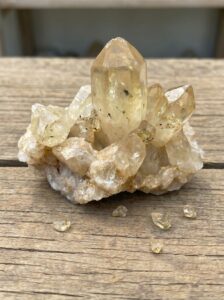
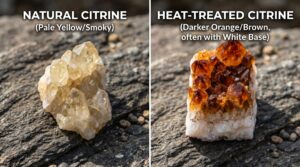
“Citrine’s Dual Radiance: The rare natural Citrine (left) boasts a subtle yellow, while the more common heat-treated Amethyst Citrine (right) offers vibrant oranges, both forms of SiO2 (Quartz).”
Physical Characteristics
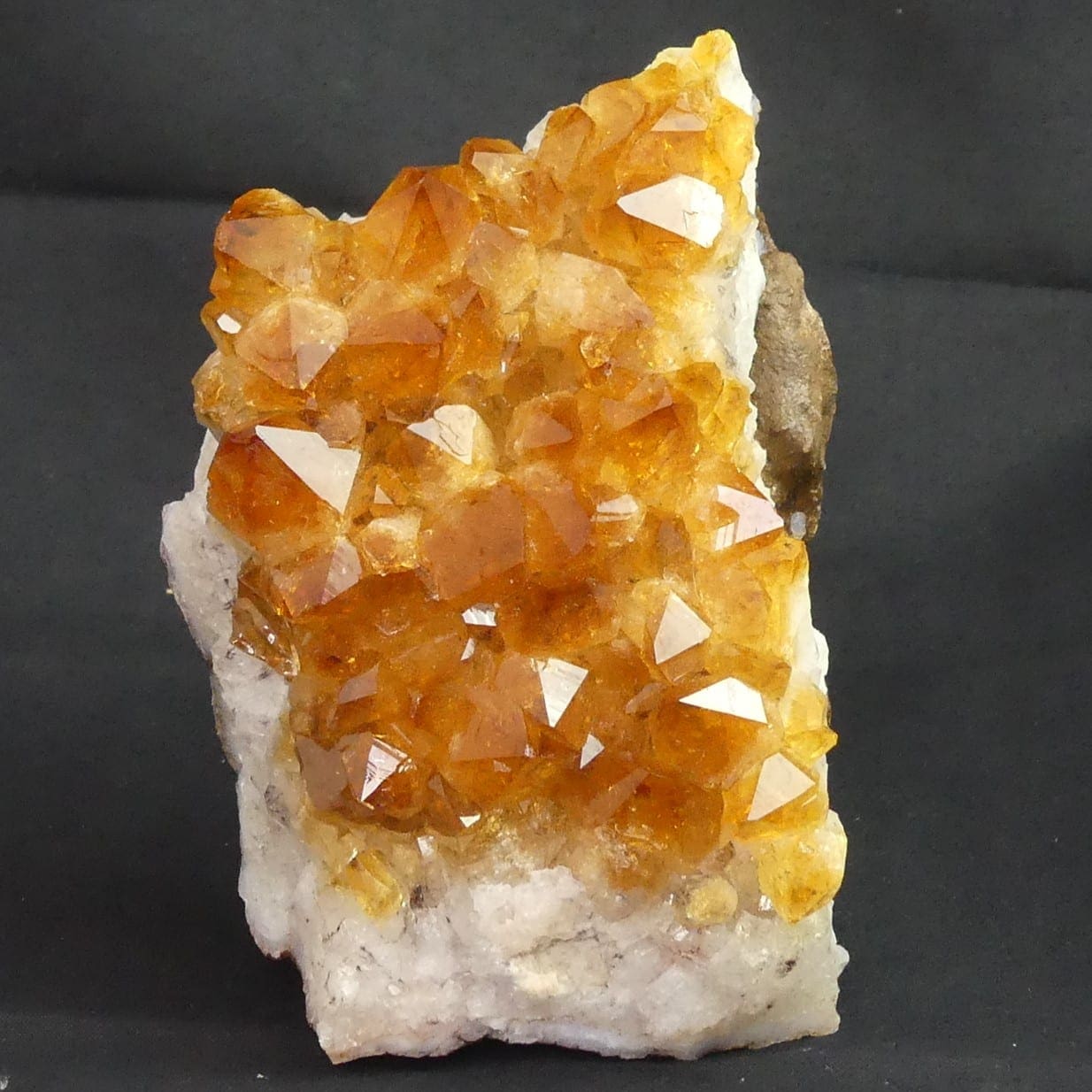
Citrine’s color range is its most notable feature, from pale yellow to golden-orange and reddish-brown. Natural Citrine tends to be paler yellow or smoky-golden, while heat-treated Amethyst often exhibits distinct reddish-orange or deep amber tones, sometimes with a white, opaque base if it was originally a geode.
It is transparent to translucent, allowing light to pass through. Like all quartz varieties, it has a vitreous (glassy) luster.
With a Mohs hardness of 7, Citrine is a durable gemstone, suitable for a wide variety of jewelry and decorative uses. It forms in hexagonal prismatic crystals, often as geode formations or large points, similar to Amethyst and Clear Quartz.
Origins & Geography
Citrine, both natural and heat-treated, is sourced from various locations around the world where quartz deposits are found.
Major sources of Citrine include:
- Brazil: The most significant source, particularly for the Amethyst that is heat-treated to become Citrine. Southern Brazil is also a source of some natural Citrine.
- Bolivia: Known for its unique “Ametrine,” a natural combination of Amethyst and Citrine, showing that natural Citrine can occur there.
- Madagascar: A key source of high-quality natural Citrine, often with a pale yellow to smoky-golden hue.
- Russia (Ural Mountains): Historical source of natural Citrine.
- Spain, France: Other notable occurrences of natural Citrine.
- USA (North Carolina, Colorado): Some smaller deposits.

“Citrine’s Global Glow: Predominantly sourced from Brazil, Bolivia, and Madagascar, these regions yield the golden quartz that brightens the world.”
Cultural History & Legends
Citrine has been used and admired since ancient times, associated with warmth, sunshine, and prosperity.
- Ancient Rome: Used for intaglios and cabochons, often believed to offer protection against evil thoughts.
- Ancient Greece: Worn as a talisman against snake venom and evil thoughts.
- Medieval Europe: Believed to bring good fortune, calm anger, and increase intuition. It was also thought to be a protection against the plague.
- 17th Century Scotland: Used to adorn dagger handles.
- Victorian Era: Popular for jewelry, especially during the Art Deco period, favored for its vibrant colors.
- Modern Metaphysics: Celebrated as the “Merchant’s Stone” or “Success Stone” for its ability to attract wealth and prosperity. It is one of the few crystals that is said to “cleanse itself” and not hold negative energy, instead transmuting it.
Spiritual, Emotional, Mental & Physical Healing
Citrine is a powerful stone for attracting abundance, fostering joy, and empowering personal will.
- Spiritual: Citrine is a stone of light, happiness, and spiritual alignment. It cleanses the aura, transmutes negative energy, and never needs cleansing itself. It draws in abundant spiritual energy, helping one to align with their higher purpose and manifest their desires into physical reality. It promotes generosity and sharing, ensuring that wealth and joy flow both to and from the user. It can stimulate the Crown Chakra to connect with divine wisdom, while still being strongly grounded in material manifestation.
- Emotional: Citrine is a powerful emotional healer, bringing joy, optimism, and enthusiasm. It helps to overcome depression, fears, and phobility, promoting a positive outlook on life. It enhances self-esteem, self-confidence, and personal power, encouraging one to embrace their authentic self. It helps to release feelings of inadequacy and encourages stepping into one’s full potential. Its sunny disposition can lift spirits and instill a sense of well-being.
- Mental: Citrine enhances mental clarity, focus, and creativity. It helps to stimulate the brain, promoting quick thinking, analytical abilities, and problem-solving skills. It is excellent for concentration and for transforming ideas into action. It can help to overcome self-doubt and fear of failure, encouraging new ventures and perseverance. It dissolves negative thought patterns and promotes a more resilient and optimistic mindset.
- Physical: Citrine is often used to energetically support digestion, metabolism, and the endocrine system. It is believed to help with chronic fatigue syndrome, reverse degenerative diseases, and balance chemical imbalances in the body. It is thought to cleanse and purify the physical body, aiding in detoxification and improving circulation. It can also be beneficial for soothing issues of the skin, nails, and hair. Its energizing vibrations are thought to boost overall physical vitality and stamina.
Uses: Meditation, Ritual, Relationships, Therapy
Citrine’s vibrant energy makes it versatile for various practices, especially those focused on abundance and positivity.
- Meditation: Meditating with Citrine can enhance feelings of joy, optimism, and abundance. Placing it on the Solar Plexus or Sacral Chakra during meditation can stimulate creativity, personal power, and manifestation abilities.
- Ritual: Used extensively in rituals for attracting wealth, prosperity, business success, and abundance. It’s excellent for gridding a space for financial growth or for use in manifestation altars. It can be used when setting intentions for new ventures, attracting positive opportunities, or overcoming scarcity mindsets.
- Relationships: Citrine promotes joy, generosity, and positive communication in relationships. It helps to dissolve conflict by encouraging optimism and understanding. It can attract new friendships and partnerships based on mutual respect and shared goals. It also boosts self-esteem, which is foundational for healthy relationships.
- Therapy: In crystal healing, Citrine is frequently placed on the Solar Plexus (for personal power) or Sacral Chakra (for creativity and manifestation). It’s used to help clients overcome depression, anxiety, fear of failure, or scarcity beliefs. Its energizing properties are beneficial for boosting vitality and emotional resilience during therapy sessions.
Chakras Activated
Citrine primarily activates the lower and higher chakras, bridging personal power with divine wisdom and manifestation.
- Solar Plexus Chakra (Manipura): Located above the navel, governing personal power, will, confidence, and self-esteem. Citrine strongly activates this chakra, empowering one to manifest their desires and take confident action.
- Sacral Chakra (Svadhisthana): Located below the navel, associated with creativity, passion, pleasure, and manifestation. Citrine energizes this chakra, enhancing creative flow, increasing vitality, and aiding in bringing ideas into form.
- Crown Chakra (Sahasrara): Located at the top of the head, associated with spiritual connection and enlightenment. Citrine can also connect to the Crown, bringing light, joy, and helping to align one’s will with divine guidance for manifestation.

“Citrine’s Empowering Glow: Igniting the Solar Plexus for personal power and the Sacral for creativity, while connecting the Crown for divine guidance in manifestation.”
Wearing, Home, and Workplace Uses
Citrine’s durability and beneficial energies make it excellent for everyday wear and various placements.
- Wearing: Wearing Citrine jewelry (pendants, necklaces, earrings, bracelets, rings) keeps its joyful, abundant, and empowering energies close throughout the day. Its durability (Mohs 7) makes it suitable for regular wear. A ring on the dominant hand or a pendant over the Solar Plexus is excellent for attracting abundance.
- Home:
- Wealth Corner: Place Citrine (especially a cluster or geode) in the wealth corner of your home (the far left corner from the main entrance) to attract prosperity and abundance.
- Living Room/Common Areas: Infuses the space with joy, optimism, and positive energy, creating a welcoming and uplifting atmosphere.
- Office/Study: Aids in focus, creativity, and manifesting success.
- Any Area of Stagnation: Its energy cleansing properties can refresh stagnant spaces.
- Workplace:
- Cash Register/Desk: Place a piece of Citrine near a cash register, in a money drawer, or on your desk (if you have a business) to attract sales, prosperity, and success.
- Office Space: Fosters a positive, energetic, and creative work environment, enhancing teamwork and communication. It can help alleviate workplace stress and encourage innovation.
Crystal Combinations
Citrine’s abundant and joyful energy combines well with crystals that can amplify its manifestation properties, provide grounding, or enhance spiritual connection.
- With Pyrite: Creates an exceptionally powerful combination for attracting wealth, prosperity, and business success, amplifying manifestation energies.
- With Green Aventurine: Enhances optimism, abundance, and good fortune, creating a strong synergy for overall prosperity.
- With Amethyst: (Especially if it’s natural Ametrine or combined intentionally) Creates balance, bringing spiritual wisdom (Amethyst) into practical manifestation (Citrine), and transmutes negative energy.
- With Clear Quartz: Amplifies Citrine’s energies, making its effects more potent and widespread throughout the aura and environment.
- With Garnet: Enhances passion, courage, and vitality, boosting the lower chakra energies for creation and drive.
- With Carnelian: Amplifies creativity, motivation, and vitality, creating a powerful combination for taking action on one’s goals.
Shapes & Forms
Citrine is commonly found in various polished and raw forms, often as clusters or points.
- Geodes/Clusters: Natural (rare) or heat-treated Amethyst geodes are very popular, often with large, beautiful crystals.
- Points/Towers: Polished or natural points, excellent for directing energy.
- Tumbled Stones: Smooth, polished pieces, very popular for carrying, chakra placement, or decoration.
- Cabochons: Smooth, rounded, polished pieces, widely used in jewelry for pendants, rings, and earrings.
- Spheres/Eggs: Polished spherical shapes, excellent for radiating its joyful energy evenly and for meditation.
- Carvings: Frequently carved into decorative objects or animals.
- Beads: Very popular for necklaces and bracelets.
Energy Color & Zodiac Significance
- Energy Color: Citrine’s predominant yellow to golden-orange color symbolizes joy, optimism, enthusiasm, abundance, personal power, and the life-giving energy of the sun. It represents creativity, manifestation, and the warmth of generosity.
- Zodiac Significance: Citrine resonates strongly with signs that can benefit from its joyful, abundant, and empowering properties.
- Gemini (May 21 – June 20): Enhances their intellectual curiosity and communication, bringing a joyful and optimistic approach to learning and sharing ideas.
- Aries (March 21 – April 19): Supports their pioneering spirit and drive, enhancing confidence, creativity, and success in new ventures.
- Leo (July 23 – August 22): Deeply aligns with Leo’s natural charisma, leadership, and desire for recognition, boosting their confidence, creativity, and ability to attract abundance.
- Libra (September 23 – October 22): Supports their quest for balance and harmony, enhancing optimism and attracting positive relationships and opportunities.

“Citrine’s Sunny Disposition: A powerful ally for the communicative Gemini, ambitious Aries, vibrant Leo, and balanced Libra, attracting joy, success, and prosperity.”
Cleansing, Charging & Care Instructions
Citrine is often called a “self-cleansing” stone, meaning it transmutes negative energy rather than absorbing it. However, occasional energetic refreshment can still be beneficial.
- Cleansing:
- Smudging: Pass through sage or palo santo smoke. This is an excellent and gentle method.
- Sound: Use a singing bowl or tuning fork.
- Moonlight: Place under the light of a full moon overnight. This is a gentle and effective method.
- Running Water: Hold under cool, running water for a few minutes. This is generally safe for polished, solid pieces.
- Avoid Salt: While not as damaging as for softer stones, prolonged direct contact with dry salt is generally not recommended for polished quartz surfaces.
- Charging:
- Sunlight: Place in direct sunlight for a few hours. This is an excellent and highly recommended method, as Citrine is strongly associated with solar energy. Its color is generally stable.
- Clear Quartz or Selenite: Place on a Clear Quartz cluster or Selenite charging plate.
- Earth: Place on natural earth for a few hours to re-ground its energy.
- Care:
- Durability: With a Mohs hardness of 7, Citrine is very durable for daily wear and relatively resistant to scratching.
- Avoid Harsh Chemicals: Keep away from strong acids, abrasive cleaners, and harsh detergents.
- Heat: While heat is used to create some forms of Citrine, avoid extreme or sudden temperature changes for finished pieces, as this could potentially cause fracturing, though it’s rare.
- Ultrasonic & Steam Cleaners: Generally considered safe for solid, polished Citrine.
- Storage: Store Citrine jewelry and specimens separately in a soft cloth pouch or a lined box to prevent scratching from harder objects.
Authenticity Tips
Due to its popularity and the fact that much of it is heat-treated Amethyst, understanding authenticity for Citrine is key.
- Color Uniformity & Intensity:
- Natural Citrine: Tends to be a pale, smoky yellow or light golden-brown, often with subtle variations, and can sometimes be almost transparent. Rarely a vibrant orange.
- Heat-Treated Amethyst (most common “Citrine”): Usually a deeper orange, reddish-brown, or amber. Often has a white, cloudy base (if it was a geode) where the crystals start to form, and the color will be most intense at the tips. The color tends to be very uniform once it’s set.
- Beware: Bright, artificial-looking “lemon-yellow” or “orange” that looks like candy might be dyed glass or overly treated material.
- Price: Natural Citrine is much rarer and thus generally more expensive than heat-treated Citrine. If a large, clear, deep yellow/orange crystal is very cheap, it’s almost certainly heat-treated.
- Clarity: Natural Citrine often has good clarity. Heat-treated geodes may have a clear tip but a cloudy or white base.
- Hardness: Should be Mohs 7. If easily scratched, it’s an imitation (glass, plastic).
- Common Imitations/Look-alikes:
- Dyed Glass: Lacks natural inclusions, feels lighter, can scratch easily.
- Dyed Quartz: Less common but possible.
- Yellow Aventurine: Opaque, with small mica inclusions (sparkles), different texture.
FAQ Section
- Q: What is Citrine used for metaphysically?
- A: Citrine is used for attracting abundance and prosperity, joy, optimism, creativity, manifestation, cleansing negative energy, and boosting personal power.
- Q: Is all Citrine heat-treated?
- A: No, not all Citrine is heat-treated, but the vast majority of commercial Citrine is. Natural Citrine is much rarer and typically has a lighter, more pale yellow or smoky-golden color.
- Q: Can Citrine attract money?
- A: Yes, Citrine is widely known as the “Merchant’s Stone” or “Success Stone” and is highly regarded in crystal healing for its ability to attract wealth, prosperity, and financial abundance.
- Q: What chakra is Citrine good for?
- A: Citrine primarily activates the Solar Plexus Chakra (personal power, confidence) and the Sacral Chakra (creativity, manifestation). It also has a connection to the Crown Chakra for joy and spiritual alignment.
- Q: Does Citrine need to be cleansed?
- A: Citrine is often called “self-cleansing” because it transmutes negative energy rather than absorbing it. However, many practitioners still recommend occasional energetic refreshing (e.g., in moonlight or sunlight) to keep its vibrations optimal.
Final Summary / Closing Thoughts
Citrine, with its vibrant, sun-kissed hues, truly embodies the essence of joy and abundance. Whether born from the rare processes of natural Earth or lovingly transformed by heat from Amethyst, it remains a powerful beacon of optimism and manifestation. More than just a beautiful gemstone, it is a generous ally, a creative spark, and a reminder that prosperity flows freely when approached with a grateful and empowered heart. Embracing Citrine’s radiant energy allows us to attract our desires, cultivate inner sunshine, and share our abundance, reflecting the boundless joy and limitless potential it represents.