Pyrite: The Stone of Abundance, Protection, and Willpower
Overview & Quick Facts
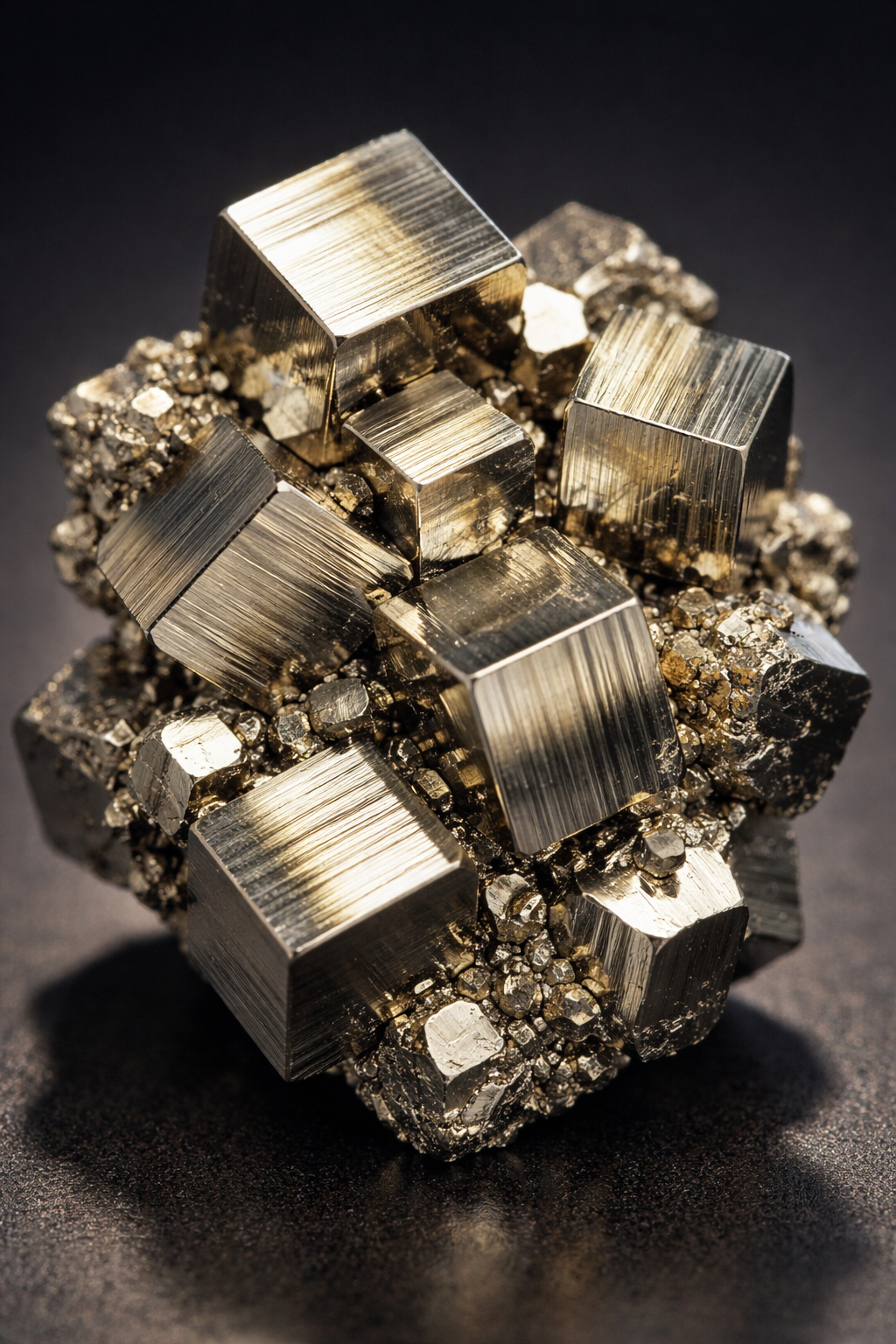
Pyrite, often nicknamed “Fool’s Gold” due to its deceptive metallic luster and brassy yellow color, is an iron sulfide mineral. It frequently forms in well-defined cubic, octahedral, or pyritohedral crystals, as well as in striking radiating or botryoidal (grape-like) masses, or the popular “Pyrite Suns” or “Pyrite Dollars.” Its metallic sheen and crystal forms make it a captivating mineral specimen. Despite its “fool’s gold” moniker, Pyrite is a powerful and highly regarded stone in the metaphysical world. Metaphysically, Pyrite is revered as the “Stone of Abundance,” “Protection,” and “Willpower.” It is highly valued for its ability to attract wealth and prosperity, shield against negative energies (both physical and energetic), and boost confidence and assertiveness. It is considered a powerful ally for stimulating the intellect, enhancing logical thinking, and providing the courage to pursue one’s goals, making it an excellent tool for manifesting success, fostering a strong sense of self, and embracing masculine energy.
- Name: Pyrite (from Greek “pyr” meaning fire, as it produces sparks when struck by metal)
- Color: Pale brassy yellow, golden metallic.
- Mineral Class: Sulfide
- Chakras: Solar Plexus (Manipura), Sacral (Svadhisthana), Root (Muladhara)
- Zodiac: Leo (for confidence and leadership), Scorpio (for protection and willpower)
- Element: Fire, Earth
- Planetary Association: Mars, Sun
- Hardness (Mohs Scale): 6 – 6.5
- Crystal System: Isometric (Cubic)
- Numerical Vibration: 3
- Composition: FeS2 (Iron Disulfide)
- Transparency: Opaque
- Luster: Metallic, bright
- Key Properties: Abundance, prosperity, protection, willpower, confidence, intellect, manifestation, shielding, energy boost, emotional stability.
Scientific Formation & Composition
Pyrite is an iron disulfide mineral with the chemical formula FeS2. It is one of the most common sulfide minerals and can form under a wide variety of geological conditions.
Its formation typically occurs in:
- Igneous Rocks: As an accessory mineral crystallizing from magma.
- Metamorphic Rocks: Forms under heat and pressure in many metamorphic rocks.
- Hydrothermal Veins: Common in veins formed by hot, mineral-rich fluids, often associated with ore deposits (gold, copper, etc.).
- Sedimentary Rocks: Abundant in sedimentary environments, where it forms in anoxic (oxygen-depleted) conditions, often as a replacement mineral for organic material (e.g., in shale, coal). Pyrite concretions and fossils are common.
- Biogenic Origin: Some pyrite forms through the activity of sulfate-reducing bacteria in anaerobic environments.
- “Pyrite Suns” / “Pyrite Dollars”: These unique, disc-shaped formations are found embedded in shale and coal seams, particularly in Illinois, USA. They are believed to have formed in flat, compressed environments, possibly as concretions around an organic nucleus.


“Pyrite’s Golden Geometry: An iron disulfide (FeS2), Pyrite commonly forms in striking cubic, octahedral, or pyritohedral crystals, often found in sedimentary and metamorphic rocks. Its metallic brilliance, though sometimes mistaken for gold, is a testament to its unique geological formation.”
Physical Characteristics
Pyrite’s metallic sheen and crystal forms are its most recognizable features.
- Color: Distinctive pale brassy yellow to golden metallic. Can tarnish to a darker, duller yellow-brown over time if exposed to moisture.
- Luster: Bright metallic, giving it a dazzling, reflective appearance.
- Transparency: Opaque. Light does not pass through it.
- Hardness: Relatively hard, with a Mohs hardness of 6 – 6.5. This means it can scratch glass but can be scratched by harder minerals like quartz.
- Density: Relatively heavy for a non-metallic mineral due to its iron content.
- Crystal System: Isometric (Cubic). It famously forms perfect cubes, but also dodecahedrons (pyritohedrons) and octahedrons. Crystals often have striations on their faces.
- Cleavage: Indistinct.
- Fracture: Uneven to conchoidal.
- Streak Color: Greenish-black to brownish-black (important for distinguishing from gold, which has a yellow streak).
- Sulfur Scent: When scratched or struck, it often emits a faint sulfurous smell.
Origins & Geography
Pyrite is a widely distributed mineral found in numerous localities around the world.
Major sources of Pyrite include:
- Spain (Navajún, La Rioja): World-renowned for producing exceptionally perfect, large cubic crystals.
- Peru: A major source, producing beautiful clusters, often with other minerals.
- USA (Illinois – for Pyrite Suns; Colorado, Arizona): Illinois is famous for its unique “Pyrite Suns” or “Pyrite Dollars.” Other states have various forms.
- Italy, Brazil, China, Greece, Russia, South Africa: Other significant sources, producing a variety of Pyrite forms and crystal habits.
Cultural History & Legends
Despite its commonality, Pyrite has a history intertwined with both practical and mystical uses.
- “Fool’s Gold”: Its most famous moniker. Throughout history, particularly during gold rushes, prospectors were often fooled by its metallic luster, mistaking it for real gold. This gave it its deceptive reputation.
- Ancient Civilizations: Pyrite has been used since ancient times.
- Pre-Columbian Americas (Incas): Polished Pyrite was used by the Incas and other ancient American civilizations for mirrors, particularly for divination and scrying.
- Ancient Greece & Rome: Its name comes from the Greek “pyr” (fire), as striking it with steel produces sparks, a property used for fire starting (flintlock mechanisms later utilized this).
- Protection & Shielding: Historically, and in modern metaphysical practices, Pyrite has been used as a protective stone, believed to deflect negative energies and dangers.
- Alchemy: In alchemy, iron (and thus Pyrite) was associated with masculinity and aggressive qualities, related to the planet Mars.
Spiritual, Emotional, Mental & Physical Healing
Pyrite is a dynamic stone that empowers, protects, and stimulates, particularly relating to confidence and manifestation.
- Spiritual: Pyrite is a potent spiritual protector and grounding stone. It creates a powerful shield against all forms of negative energy, environmental pollutants, and psychic attack. It enhances the masculine principle of assertiveness, willpower, and action. It encourages spiritual wisdom and connection to the Earth’s energy, helping to ground high-vibrational insights into practical reality. It is an excellent stone for manifesting abundance and prosperity from a place of aligned action and strong intention, bringing “golden” opportunities into one’s life. It encourages inner vision and understanding of one’s true potential.
- Emotional: Pyrite greatly boosts confidence, self-worth, and willpower. It helps to overcome feelings of inadequacy, fear, and anxiety. It instills a sense of courage and daring, especially when facing challenging situations or pursuing ambitious goals. It helps to release emotional blockages that prevent one from taking action or asserting themselves. It fosters emotional stability and a practical approach to problems, reducing emotional reactivity and encouraging self-reliance. It can help in moving past victim mentality.
- Mental: Pyrite is a powerful stimulator of the intellect and logical thinking. It enhances memory, concentration, and analytical abilities, making it excellent for students, researchers, or anyone needing mental clarity. It helps to discern truth from illusion, cutting through confusion and providing clear insight. It encourages creativity and the development of new ideas, especially when linked to manifestation. It helps to overcome procrastination and provides the mental stamina needed to complete projects. It encourages an optimistic and resourceful mindset.
- Physical: Energetically, Pyrite is believed to boost physical energy and vitality, combating fatigue and increasing stamina. Its iron content is sometimes linked to its perceived ability to support the circulatory system and improve oxygenation of the blood. It is thought to strengthen the digestive tract, reduce inflammation, and alleviate symptoms of respiratory issues like bronchitis and asthma. Some practitioners use it to energetically support the endocrine system and stimulate cellular regeneration. Its protective qualities are also said to extend to shielding against environmental pollutants and electromagnetic fields.
Uses: Meditation, Ritual, Relationships, Therapy
Pyrite’s empowering and protective energies make it a versatile tool for personal development, manifestation, and energetic shielding.
- Meditation: Meditating with Pyrite can bring immediate clarity, boost confidence, and stimulate the Solar Plexus for empowerment. Holding it or placing it on your desk during meditation can help ground intentions for manifestation and shield your energy field. It can help access inner strength and overcome self-doubt during spiritual introspection.
- Ritual: Used in rituals for abundance, prosperity, protection (especially for spaces), willpower, career success, and energetic shielding. It can be placed in crystal grids for manifestation, financial growth, or to create a protective barrier. It’s excellent for new beginnings, goal setting, or any ritual aimed at empowering oneself and attracting success.
- Relationships: Pyrite fosters assertiveness, confidence, and clear communication in relationships. It helps individuals to stand in their power, set healthy boundaries, and avoid being manipulated. It encourages honesty and integrity. While not a “love stone,” it helps one attract relationships based on mutual respect and empowerment, and can help overcome shyness or insecurity in social interactions.
- Therapy: In crystal healing, Pyrite is a valuable tool for clients struggling with low self-esteem, lack of motivation, financial blocks, or those needing protection from negative influences. Practitioners often place it on the Solar Plexus for empowerment, on the Root for grounding and protection, or use it in grid layouts for abundance and shielding. It helps clients to overcome fear, take action, and manifest their desires.
Chakras Activated
Pyrite primarily activates the lower chakras, particularly the Solar Plexus, Sacral, and Root, linking willpower, creativity, and grounding.
- Solar Plexus Chakra (Manipura): Located above the navel, associated with personal power, willpower, confidence, and self-esteem. Pyrite strongly activates this chakra, boosting courage and assertiveness.
- Sacral Chakra (Svadhisthana): Located below the navel, associated with creativity, passion, emotions, and pleasure. Pyrite can stimulate this chakra, linking passion with action and manifestation.
- Root Chakra (Muladhara): Located at the base of the spine, associated with grounding, stability, security, and basic needs. Pyrite helps to ground energies and create a sense of secure foundation for action.
Wearing, Home, and Workplace Uses
Pyrite’s protective and prosperity-attracting energies make it ideal for personal wear and for empowering specific environments.
- Wearing: Pyrite is popular in jewelry, often in its raw, natural form or as polished spheres/cabochons in pendants, rings, and bracelets. Wearing Pyrite provides continuous energetic protection, boosts confidence, and attracts opportunities for success and abundance throughout the day.
- Home:
- Wealth Corner (Feng Shui): Place Pyrite in the southeast corner of your home (or the wealth corner of any room) to attract abundance and prosperity.
- Entryway: Near the front door to act as a protective shield against negative energy entering your home.
- Desk/Study Area: For mental clarity, focus, and motivation in intellectual pursuits.
- Wherever Protection is Needed: Can be placed throughout the home for general energetic shielding.
- Workplace:
- Desk/Office: Ideal for attracting business success, promoting clear thinking, boosting confidence in presentations, and providing protection from negative office politics or energetic drains.
- Cash Register/Financial Areas: To attract financial abundance and secure transactions.
- Creative Spaces: For stimulating new ideas and overcoming creative blocks, linking intellect with manifestation.
Crystal Combinations
Pyrite’s empowering and protective energy combines well with stones that enhance its manifestation abilities, provide further grounding, or balance its fiery nature.
- With Citrine or Green Aventurine: Creates a powerful duo for attracting wealth, abundance, and success. This is a classic combination for prosperity.
- With Black Tourmaline or Hematite: Amplifies Pyrite’s protective qualities, creating a stronger energetic shield against negativity and electromagnetic smog, while also enhancing grounding.
- With Carnelian or Garnet: To boost physical energy, passion, and vitality, strengthening the connection to creative action and manifestation from the lower chakras.
- With Clear Quartz or Selenite: Amplifies Pyrite’s manifestation and protective properties, making its energy more potent and pervasive, while also adding cleansing elements.
- With Tiger’s Eye: Enhances willpower, courage, and decision-making, helping one to take bold, confident action towards goals.
- With Shungite: For enhanced protection against electromagnetic frequencies (EMFs) and geopathic stress, creating a very strong protective field.
Shapes & Forms
Pyrite is highly valued for its unique crystal habits and distinct forms.
- Cubic Crystals: The most iconic and sought-after form, often found as perfectly formed cubes, sometimes in clusters.
- Pyritohedral/Octahedral Crystals: Other isometric crystal forms that are also highly prized.
- Pyrite Suns / Pyrite Dollars: Unique disc-shaped formations with radiating striations, primarily from Illinois, USA.
- Massive/Natural Clusters: Irregular masses or formations of many intergrown crystals, used for display or general energetic purposes.
- Tumbled Stones: Polished smooth, common and affordable for carrying or grids.
- Spheres/Eggs: Polished into these forms, often showing the metallic luster beautifully.
- Fossils/Concretions: Pyrite often replaces organic material, creating pyritized fossils or concretions that retain the original shape.
Energy Color & Zodiac Significance
- Energy Color: Pyrite’s energy color is predominantly golden yellow and metallic sheen, symbolizing:
- Golden Yellow: Wealth, prosperity, abundance, success, confidence, intellect, personal power, solar energy, masculine energy.
- Metallic Sheen: Protection, shielding, reflection of negativity, strength, resilience.
- Zodiac Significance: Pyrite’s powerful, protective, and empowering qualities resonate strongly with signs that are bold, confident, and ambitious.
- Leo (July 23 – August 22): Aligns perfectly with Leo’s natural leadership, confidence, and desire for success, boosting their creative and assertive energies.
- Scorpio (October 23 – November 21): Supports Scorpio’s intense willpower, protective nature, and ability to delve deep, helping them to manifest desires and shield against negativity.
- Aries (March 21 – April 19): Enhances Aries’ pioneering spirit, courage, and drive to initiate new ventures, providing protection and stamina.
Cleansing, Charging & Care Instructions
Pyrite is a relatively stable mineral, but its iron and sulfur content require specific care to prevent tarnishing or degradation.
- Cleansing:
- Smudging: Pass through sage or palo santo smoke. This is the most recommended and safest method for Pyrite.
- Sound: Use a singing bowl or tuning fork. Highly effective and safe.
- Visualization/Intention: Due to its inherent protective qualities, Pyrite doesn’t hold much negative energy and can often be cleared with strong intention.
- Avoid Water (Especially Salt Water): Crucially, AVOID PROLONGED WATER EXPOSURE, particularly salt water. Pyrite is an iron sulfide and can oxidize (rust) or react with water, especially if there are other sulfide impurities present (like marcasite), leading to the formation of sulfuric acid and potentially damaging the crystal. It can cause a sulfur smell, discoloration, and disintegration. A quick, gentle rinse with distilled water followed by immediate and thorough drying is generally acceptable for physical cleaning, but it’s best to avoid it for energetic cleansing.
- Avoid Harsh Chemicals/Acids: Will damage the stone.
- Charging:
- Sunlight: Pyrite can be charged in direct sunlight for a few hours to enhance its fiery, masculine energy and amplify its manifestation properties.
- Moonlight: Place under the light of a full moon overnight for a more balanced charge.
- Earth: Bury in dry earth (in a cloth bag to keep clean) overnight for deep grounding and revitalization.
- Clear Quartz Cluster: Place on a Clear Quartz cluster to amplify its energy.
- Care:
- Moisture Sensitivity: Pyrite is susceptible to oxidation if exposed to high humidity or water. This can lead to a rust-like discoloration or even degradation of the crystal over time (“Pyrite disease”).
- Store in Dry Environment: Keep Pyrite specimens in a low-humidity environment. Desiccant packets (like silica gel) can be placed in display cases with valuable specimens.
- Handle with Care: While hard, its sharp edges, especially on cubic crystals, can chip if dropped.
- Ultrasonic & Steam Cleaners: NEVER use ultrasonic or steam cleaners on Pyrite. The water and vibrations will cause damage. Dry cleaning with a soft cloth is the only recommended physical cleaning method.
- Chemical Sensitivity: Avoid contact with harsh chemicals, strong detergents, perfumes, hairspray, and cosmetics.
- Storage: Store Pyrite specimens separately in a soft cloth or box to prevent scratching other softer stones or being scratched by harder ones.
Authenticity Tips
Distinguishing genuine Pyrite, especially from actual gold, is relatively straightforward with simple tests.
- Color & Luster: Genuine Pyrite has a distinct brassy-yellow, metallic luster that is paler than gold and often has a slightly more greenish tint. Gold is a richer, softer yellow.
- Hardness: Pyrite is much harder than gold. Pyrite will scratch glass (Mohs 6-6.5), while pure gold is very soft (Mohs 2.5-3) and cannot scratch glass.
- Streak: The most definitive test (destructive to the specimen if done on a prominent surface): Pyrite leaves a greenish-black to brownish-black streak when rubbed on an unglazed porcelain tile. Gold leaves a golden yellow streak.
- Weight: Pyrite is heavy, but gold is much, much denser. A piece of gold of the same size would feel significantly heavier than a piece of Pyrite.
- Malleability: Pyrite is brittle and will shatter or break when struck. Gold is malleable and ductile; it will flatten or dent when struck, not break.
- Crystal Habit: Look for characteristic cubic, pyritohedral, or octahedral forms, or radiating “suns.” Gold typically does not form such distinct, sharp crystals.
- Common Look-alikes/Imitations:
- Gold (real): As described above, different hardness, streak, color, density, and malleability.
- Chalcopyrite: Another sulfide, but typically has a more golden-yellow to brassy-yellow color often with iridescent tarnish, and is softer (Mohs 3.5-4).
- Marcasite: Chemically identical to Pyrite (FeS2) but forms in an orthorhombic crystal system. Often has a paler, silvery-yellow color and can be more unstable and prone to degradation (“Pyrite disease”). Jewelers often use “marcasite” loosely to refer to faceted Pyrite.
- Dyed Materials/Fakes: Unlikely to imitate Pyrite’s metallic luster well.
FAQ Section
- Q: What is Pyrite known for metaphysically?
- A: Pyrite is known as “Fool’s Gold,” but metaphysically it’s a powerful stone for abundance, protection, willpower, confidence, and stimulating the intellect.
- Q: Can Pyrite go in water?
- A: It is highly recommended to AVOID WATER for Pyrite, especially prolonged soaking or salt water, as it is an iron sulfide and can rust or degrade over time. Use dry cleansing methods.
- Q: Why is Pyrite called “Fool’s Gold”?
- A: It’s called “Fool’s Gold” because its metallic luster and brassy yellow color closely resemble real gold, leading prospectors to often mistake it for the precious metal.
- Q: How does Pyrite help with abundance?
- A: Pyrite’s energy is highly conducive to attracting wealth, prosperity, and good fortune. It boosts confidence, willpower, and mental clarity, helping you to take inspired action and manifest your goals.
- Q: How should I cleanse Pyrite?
- A: The best ways to cleanse Pyrite are smudging (with sage or palo santo), sound cleansing (singing bowl), or placing it under moonlight. Avoid water.
Final Summary / Closing Thoughts
Pyrite, with its unmistakable golden gleam and robust energy, stands as a testament to the power of manifestation, protection, and inner strength. Far from being “fool’s gold,” it is a truly wise ally that empowers the mind, ignites the will, and shields the spirit from negativity. Embracing Pyrite’s formidable essence allows us to attract abundance, cultivate unwavering confidence, and boldly pursue our highest aspirations, truly reflecting the boundless prosperity and resolute power it so magnificently bestows.