Sodalite: The Stone of Intuition, Logic, and Truthful Communication
Overview & Quick Facts
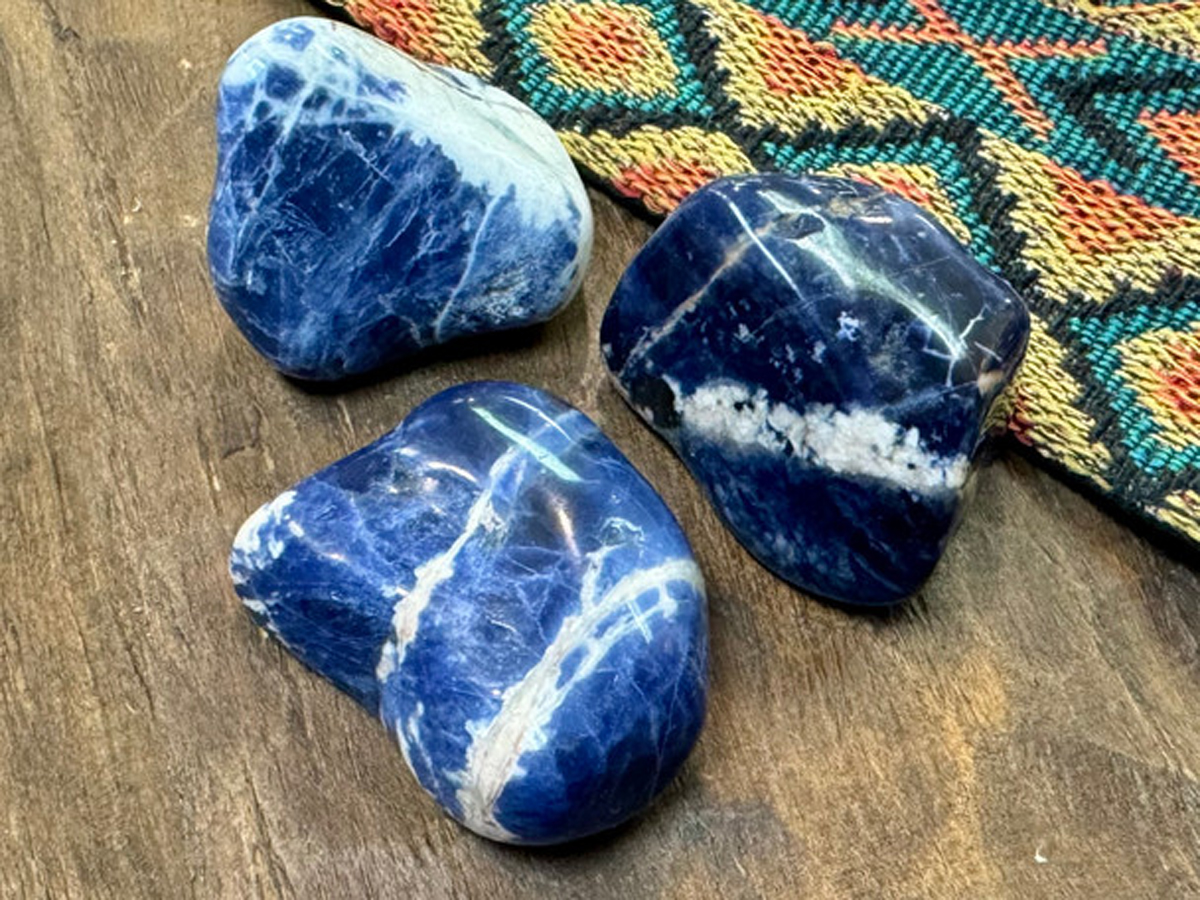
Sodalite is a deep blue, opaque mineral, often characterized by distinctive white calcite veins or streaks, and sometimes small black inclusions. It is a tectosilicate mineral, part of the sodalite group, named for its sodium content. Its color ranges from a vibrant royal blue to a paler, grayish-blue, and it can sometimes be found with pink or reddish hues due to impurities (such as Hackmanite, a rare variety of sodalite that can be photochromatic). Sodalite typically forms in massive, granular habits, making it popular for carvings, cabochons, and ornamental pieces. Metaphysically, Sodalite is universally revered as the “Stone of Intuition,” “Logic,” and “Truthful Communication.” It is highly valued for its profound ability to harmonize the mind and intuition, promote rational thought, and enhance self-expression. It helps to bring order and calm to a confused mind, alleviates panic attacks, and fosters emotional balance. It is considered an indispensable ally for anyone seeking clarity, inner peace, and the courage to speak their truth, making it an exceptional tool for spiritual awakening, intellectual pursuits, and fostering harmonious relationships through clear communication.
- Name: Sodalite (from “sodium” and “lithos” meaning stone, referring to its sodium content)
- Color: Deep royal blue, often with white calcite veins/streaks; sometimes grayish-blue, rarely pink/red.
- Mineral Class: Silicate (Tectosilicate – Feldspathoid group)
- Chakras: Throat (Vishuddha), Third Eye (Ajna)
- Zodiac: Sagittarius, Virgo
- Element: Water, Air
- Planetary Association: Moon, Mercury
- Hardness (Mohs Scale): 5.5 – 6
- Crystal System: Isometric (Cubic)
- Numerical Vibration: 4
- Composition: Na8(Al6Si6O24)Cl2 (Sodium Aluminum Silicate with Chlorine)
- Transparency: Opaque to translucent (rarely).
- Luster: Vitreous (glassy) to greasy.
- Key Properties: Intuition, logic, communication, emotional balance, inner peace, truth, clarity, self-expression, anxiety relief, spiritual perception.
Scientific Formation & Composition
Sodalite is a tectosilicate mineral and a member of the feldspathoid group, which means it’s a silica-deficient mineral that forms in place of feldspar when silica is scarce in the magma. Its chemical formula is Na8(Al6Si6O24)Cl2, indicating it’s a sodium aluminum silicate with chlorine.
Its formation typically occurs in:
- Alkaline Igneous Rocks: Sodalite commonly forms in igneous rocks that are relatively low in silica but high in alkali metals (sodium, potassium), such as nepheline syenites and phonolites. These rocks solidify from magmas that are undersaturated with respect to silica.
- Contact Metamorphic Rocks: Less commonly, it can form in contact metamorphic rocks, where existing rocks are altered by the heat and chemical reactions from nearby magma.
- Hydrothermal Veins: It can also be found in hydrothermal veins associated with these rock types.
The distinctive white veins often seen in Sodalite are usually calcite or other white minerals that have filled fractures within the Sodalite over time. The blue color is often attributed to the presence of chloride ions within its cage-like structure, which, when activated by certain conditions (like radiation), can create color centers.

“Sodalite’s Harmonious Hues: A sodium aluminum silicate (Na8(Al6Si6O24)Cl2), Sodalite forms in silica-poor igneous rocks. Its deep blue is often interlaced with white calcite veins, symbolizing its ability to blend intuition and logic for clear communication.”
Physical Characteristics
Sodalite’s deep blue color and characteristic white veins are its most identifiable physical traits.
- Color: Ranges from a rich royal blue to indigo, often mottled with white (calcite) and sometimes black (other mineral inclusions like manganese). Pure blue Sodalite is rare.
- Luster: Vitreous (glassy) to greasy.
- Transparency: Almost always opaque, though very thin pieces might show slight translucency.
- Hardness: Moderate, with a Mohs hardness of 5.5 – 6. It’s softer than quartz but durable enough for most jewelry.
- Density: Moderate.
- Crystal System: Isometric (Cubic). However, it rarely forms distinct, well-formed crystals and is typically found in massive, granular aggregates.
- Cleavage: Distinct dodecahedral cleavage, meaning it tends to break along specific planes in a 12-sided shape, though this is often not visible in massive forms.
- Fracture: Uneven to conchoidal.
- Streak Color: White.
- Fluorescence: Can sometimes show weak orange fluorescence under UV light.
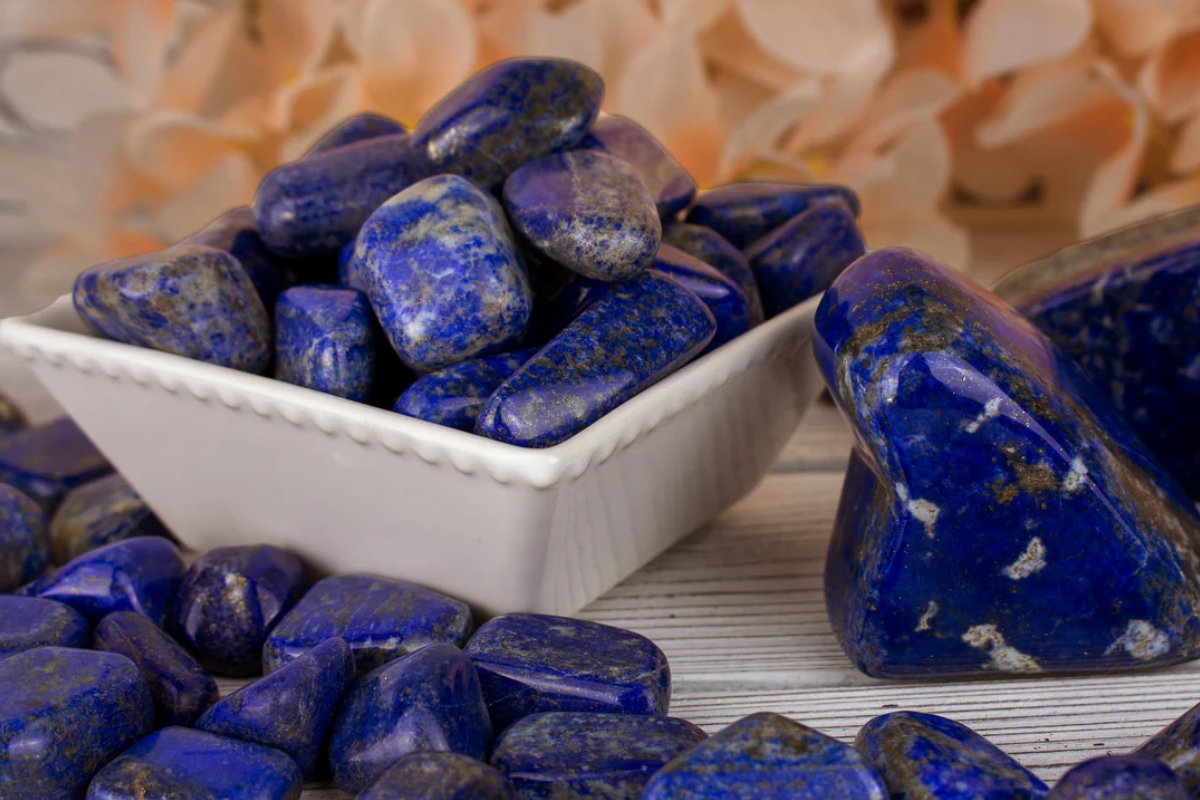
- Distinguishing from Lapis Lazuli: While often confused, Sodalite’s white veins (calcite) differentiate it from Lapis Lazuli, which typically has golden pyrite flecks and a more uniform color. Sodalite also has a lower hardness and no sulfuric odor when freshly broken (unlike Lapis).
Origins & Geography
Sodalite deposits are found in various localities around the world, often associated with specific types of alkaline igneous rocks.
Major sources of Sodalite include:
- Brazil: A primary source for large quantities of good quality Sodalite.
- Namibia (Kunene Region): Known for producing high-quality, often very blue Sodalite.
- Canada (Ontario): Famous for “Princess Blue” Sodalite, found in the Bancroft area, often with significant white veining.
- USA (Arkansas, Maine, Montana): Various smaller deposits.
- India, Russia, Greenland, Italy (Vesuvius): Other notable localities producing Sodalite.

“Sodalite’s Global Reach: Found in the rich deposits of Brazil, the vibrant mines of Namibia, and the unique Princess Blue regions of Canada, Sodalite emerges from diverse alkaline igneous rocks worldwide, bringing its harmonizing and truthful energies across the globe.”
Cultural History & Legends
Sodalite, while not as anciently documented as some other blue stones, has been appreciated for its beauty and qualities for centuries, gaining significant recognition in modern times.
- Ancient Americas: Some evidence suggests pre-Columbian cultures in Central and South America used Sodalite for decorative carvings and ornaments.
- Early European Discovery: Though known locally in some areas, Sodalite was officially recognized as a distinct mineral much later, in 1811, by European mineralogists in Greenland.
- Princess Patricia’s Influence: It gained significant popularity in 1891 when large deposits were found in Ontario, Canada, and then again in 1901 when the Prince of Wales (later King George V) and Princess Patricia visited the region. Princess Patricia was so captivated by the beautiful blue stone that she ordered a thousand kilograms of it to decorate her Marlborough House residence, sparking a “royal blue” craze.
- Modern Metaphysics: In contemporary crystal healing, Sodalite is highly valued for its mental and communicative properties, often referred to as the “Thinker’s Stone” or “Poet’s Stone” due to its ability to bring clarity and articulate thoughts.
Spiritual, Emotional, Mental & Physical Healing
Sodalite is a powerful stone for bridging the gap between logic and intuition, promoting clear communication and inner peace.
- Spiritual: Sodalite enhances spiritual perception, intuition, and inner wisdom. It opens and activates the Third Eye and Throat Chakras, facilitating deeper spiritual understanding and the articulation of spiritual truths. It helps in gaining insight during meditation and can aid in understanding symbolic messages. It supports a journey of self-discovery, encouraging introspection and honest self-assessment. It can help one to connect with their higher self and universal knowledge, promoting a sense of inner peace and cosmic understanding. It helps to release fear-based thought patterns that hinder spiritual growth.
- Emotional: Sodalite brings emotional balance and stability. It helps to alleviate panic attacks, phobias, and anxiety by calming the mind and encouraging rational thought in stressful situations. It fosters self-acceptance, self-trust, and self-esteem. It can aid in overcoming guilt and fear, especially fear of speaking one’s truth. It encourages emotional honesty and the release of repressed feelings in a constructive way. It is particularly soothing for highly sensitive individuals, helping them to maintain composure.
- Mental: Sodalite is an excellent stone for the mind, promoting logical thought, clarity, and rational analysis. It helps to bring order to a confused or scattered mind, enhancing focus and concentration. It is beneficial for students, writers, and researchers, aiding in learning, information retention, and articulating complex ideas clearly. It dissolves mental blocks and stubbornness, encouraging new perspectives and objective evaluation of situations. It can help in moving from emotional responses to more rational solutions.
- Physical: Energetically, Sodalite is believed to support the throat, larynx, vocal cords, and thyroid gland, promoting overall health in these areas. It is often used to energetically aid with issues related to sore throats, hoarseness, and digestive problems (due to stress). Some practitioners use it to help balance metabolism, boost the immune system, and reduce high blood pressure. It can help alleviate insomnia and reduce the effects of radiation. Its calming energy is thought to reduce inflammation and fever.
Uses: Meditation, Ritual, Relationships, Therapy
Sodalite’s ability to balance mind and emotion, and promote clear communication, makes it valuable for various personal and interpersonal applications.
- Meditation: Meditating with Sodalite can help to calm an overactive mind, deepen intuition, and facilitate connection to inner wisdom. Placing it on the Third Eye or Throat Chakra can enhance insight and prepare one for truthful self-expression. It helps in achieving a state of mental clarity and emotional peace during meditation.
- Ritual: Used in rituals for enhancing communication, promoting inner peace, balancing emotions, and revealing truth. It can be placed in crystal grids for harmony, clarity of purpose, or effective group communication. It’s excellent for rituals aimed at improving public speaking, resolving conflicts, or fostering greater self-acceptance.
- Relationships: Sodalite is a powerful stone for fostering harmonious and truthful communication in all relationships. It encourages honesty, calm dialogue, and mutual understanding. It helps individuals to articulate their thoughts and feelings clearly and respectfully, reducing misunderstandings and conflict. It promotes objectivity in heated discussions and helps to soothe emotional outbursts.
- Therapy: In crystal healing, Sodalite is a supportive stone for clients dealing with anxiety, panic attacks, communication difficulties, emotional overwhelm, or seeking greater mental clarity. Practitioners often place it on the Throat Chakra for communication issues or the Third Eye for intuition and mental balance. It empowers clients to speak their truth, trust their intuition, and find inner peace.
Chakras Activated
Sodalite primarily activates the Throat and Third Eye Chakras, linking communication with intuition and logical thought.
- Throat Chakra (Vishuddha): Located at the base of the throat, associated with communication, self-expression, truth, and creativity. Sodalite strongly activates this chakra, promoting clear and confident articulation.
- Third Eye Chakra (Ajna): Located between the eyebrows, associated with intuition, perception, wisdom, and inner vision. Sodalite balances logical thought with intuitive insight.

“Sodalite’s Intuitive Voice: Powerfully activating the Throat Chakra (Vishuddha) for truthful self-expression and harmonizing the Third Eye Chakra (Ajna) for intuitive insight and mental clarity, Sodalite bridges logic and intuition, fostering articulate and wise communication.”
Wearing, Home, and Workplace Uses
Sodalite’s balancing, communicative, and calming energies make it an excellent choice for personal wear and for infusing spaces with peace and clarity.
- Wearing: Sodalite is commonly used in jewelry (pendants, bracelets, beads, cabochons) due to its beautiful blue color and moderate hardness. Wearing Sodalite keeps its energies of clear communication, emotional balance, and enhanced intuition constantly close, benefiting public speaking, reducing anxiety, and fostering inner peace throughout the day. It’s particularly useful during meetings or presentations.
- Home:
- Common Areas: Place in living rooms or family areas to promote harmonious communication and reduce conflict.
- Bedroom: Place near the bed for peaceful sleep, to calm an overactive mind before rest, and to encourage insightful dreams.
- Study/Office: To enhance mental clarity, focus, and rational thinking, especially during intense mental work.
- Meditation Space: To deepen meditative states and enhance intuitive insights.
- Workplace:
- Desk/Workstation: Ideal for promoting clear communication, logical thought, and reducing stress in a busy environment. It can help in effective problem-solving and expressing ideas clearly to colleagues or clients.
- Meeting Rooms: Place Sodalite on the table to encourage calm, objective discussion and prevent emotional outbursts.
- For Writers/Speakers: Excellent for inspiration and articulation.
Crystal Combinations
Sodalite’s harmonizing, intuitive, and communicative energy combines well with stones that enhance its properties or complement its focus on truth and clarity.
- With Lapis Lazuli or Blue Lace Agate: To amplify communication, truth, and spiritual insight, enhancing both intuition and self-expression.
- With Amethyst or Iolite: For enhanced intuition, psychic development, and spiritual connection, allowing for clearer reception of higher guidance.
- With Clear Quartz or Selenite: Amplifies Sodalite’s mental clarity, intuitive insight, and calming properties, making its energy more potent and pervasive.
- With Black Tourmaline or Obsidian: To provide grounding and protection while exploring higher consciousness or dealing with intense mental work, ensuring stability.
- With Carnelian or Citrine: To balance Sodalite’s mental focus with creativity, passion, and manifestation, helping to bring ideas into energetic reality.
- With Hematite or Red Jasper: For very strong grounding, particularly for those who tend to be “in their head” too much, ensuring a balance between mental activity and physical presence.
Shapes & Forms
Sodalite’s typically massive habit and appealing blue color make it suitable for a wide range of polished and ornamental forms.
- Tumbled Stones: The most common and affordable form, polished smooth and perfect for carrying, grids, or general energetic use.
- Spheres/Eggs: Polished into these forms for display, meditation, and radiating harmonious energy evenly throughout a space.
- Cabochons/Beads: Widely used in jewelry (pendants, rings, bracelets, necklaces), showcasing its distinctive blue color and white veins.
- Pyramids/Obelisks/Towers: Polished into standing forms, used for directing energy and as decorative pieces in offices or meditation spaces.
- Palm Stones/ Worry Stones: Smooth, ergonomic shapes for holding during meditation or to soothe anxiety.
- Small Carvings/Figurines: Its workability allows it to be carved into various ornamental objects.
- Rough/Natural Chunks: Unpolished pieces, sometimes showing the raw mineral structure.
Energy Color & Zodiac Significance
- Energy Color: Sodalite’s energy color is primarily blue (often with white), symbolizing:
- Blue: Communication, truth, wisdom, intuition, serenity, peace, logic, clarity, self-expression.
- White (Calcite): Purity, cleansing, spiritual light, balance, inner harmony.
- The combination signifies truthful and intuitive communication grounded in mental clarity and emotional balance.
- Zodiac Significance: Sodalite’s qualities of clarity, logic, intuition, and communication resonate strongly with intellectual, communicative, and introspective zodiac signs.
- Sagittarius (November 22 – December 21): Supports Sagittarius’s quest for truth and wisdom, enhancing their philosophical thinking and ability to communicate their insights clearly.
- Virgo (August 23 – September 22): Aligns perfectly with Virgo’s analytical and practical nature, helping to calm an overactive mind, enhance logical thought, and aid in effective communication.
- Gemini (May 21 – June 20): Aids Gemini’s natural communication skills, bringing mental clarity, reducing scattered thoughts, and fostering more focused and truthful expression.
- Libra (September 23 – October 22): Supports Libra’s desire for balance and harmony, helping them to communicate fairly, make rational decisions, and find inner peace in relationships.
- Aquarius (January 20 – February 18): Enhances Aquarius’s intellectual pursuits, innovative thinking, and ability to articulate complex ideas with clarity and objective insight.
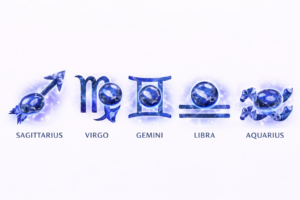
“Sodalite’s Zodiac Harmony: Clarifying Sagittarius’s wisdom, calming Virgo’s mind, enhancing Gemini’s communication, balancing Libra’s decisions, and inspiring Aquarius’s intellect, Sodalite bestows profound clarity, intuitive insight, and truthful expression upon its aligned zodiac signs.”
Cleansing, Charging & Care Instructions
Sodalite is a moderately hard stone (Mohs 5.5-6), making it generally durable but still requiring careful handling. Its energetic properties benefit from regular cleansing.
- Cleansing:
- Running Water: Hold under cool, running water for several minutes. This is safe and highly effective.
- Smudging: Pass through sage or palo santo smoke. This is an excellent and safe method.
- Sound: Use a singing bowl or tuning fork. Highly effective and safe.
- Moonlight: Place under the light of any moon phase overnight for a gentle cleanse and charge. This is an excellent and gentle method.
- Sunlight (Brief): Can be placed in direct sunlight for a few hours for a powerful charge. Sodalite is generally color-stable in sunlight, but prolonged, intense direct sunlight for very extended periods is best avoided for any colored stone to prevent any potential fading over many years.
- Earth: Bury in dry earth (in a cloth bag to keep clean) overnight for deep grounding and revitalization.
- Avoid Salt Water (Prolonged): While a quick rinse might be okay, avoid prolonged soaking in salt water, as salt can potentially get into fissures, react with its sodium content, or dull its polish over time.
- Avoid Harsh Chemicals/Acids: Will damage the stone.
- Charging:
- Moonlight: Placing it under a full moon is highly recommended for a balanced charge that enhances its intuitive and emotional properties.
- Sunlight (Brief/Indirect): A few hours in indirect sunlight or brief direct sunlight can energize its clarity and communication properties.
- Clear Quartz or Selenite: Place on a Clear Quartz cluster or Selenite charging plate to amplify its energy.
- Intention: Sodalite responds well to intention. Hold it and visualize it being filled with clear, communicative energy.
- Care:
- Durability: With a Mohs hardness of 5.5-6, Sodalite is relatively durable for everyday wear, but it can be scratched by harder materials like quartz. Avoid rough handling.
- Handle with Care: Avoid hard blows or sudden temperature changes which could cause chipping or fracturing, especially along its cleavage planes.
- Ultrasonic & Steam Cleaners: Generally not recommended for Sodalite. Ultrasonic vibrations can cause damage, and steam can react with its chemical composition or affect the white calcite inclusions. Hand cleaning with mild soap and warm water is always the safest option.
- Chemical Sensitivity: Avoid contact with harsh chemicals, strong detergents, perfumes, hairspray, and cosmetics, as these can dull the luster or react with the stone. Sodalite can be sensitive to acids.
- Cleaning (Physical Dust/Dirt): Use a soft brush or a soft cloth with mild soap and warm water. Rinse thoroughly and dry completely immediately.
- Storage: Store Sodalite jewelry or specimens separately or in a soft pouch to prevent scratching by harder gems or scratching softer ones.
Authenticity Tips
Identifying genuine Sodalite usually involves looking for its specific color, patterns, and physical properties. It is sometimes confused with Lapis Lazuli.
- Color & Pattern: Genuine Sodalite is typically a deep, rich blue, often with distinct white (calcite) veins or streaks. The white is usually not perfectly evenly distributed. If it’s pure blue with metallic golden flecks, it’s more likely Lapis Lazuli (pyrite).
- Luster: Should have a vitreous (glassy) to slightly greasy luster.
- Hardness Test: Sodalite (Mohs 5.5-6) is softer than Lapis Lazuli (Mohs 5-6 with inclusions) but can be differentiated by testing its streak color and reaction to acid.
- Streak Color: Sodalite has a white streak when rubbed on unglazed porcelain. Lapis Lazuli has a pale blue streak. This is a key differentiator.
- Feel: Should feel cool and solid to the touch.
- Odor Test (for Lapis Lazuli vs. Sodalite): If a small, unpolished area of Lapis Lazuli is touched with a drop of hydrochloric acid (or even vinegar in some cases), it might emit a faint odor of hydrogen sulfide (rotten eggs) due to its sulfur content. Sodalite will not have this odor.
- Common Look-alikes/Imitations:
- Dyed Howlite or Magnesite: Often dyed blue to imitate Sodalite or Turquoise. Look for unnaturally uniform color, plastic-like feel, or dye concentrated in cracks. They are also slightly softer (Mohs 3-3.5) and have a different internal structure.
- Glass: Will lack natural inclusions and variations, may contain bubbles, and will have a different weight and thermal conductivity.
- Plastic/Resin: Will feel warm to the touch, be very light, and lack the hardness and natural variations of stone.
Purchase Recommendation: http://www.prohealingcrystals.com
FAQ Section
- Q: What is Sodalite known for metaphysically?
- A: Sodalite is known as the “Stone of Intuition and Logic.” It’s revered for enhancing communication, promoting mental clarity, emotional balance, inner peace, and truthful self-expression.
- Q: What is the main difference between Sodalite and Lapis Lazuli?
- A: Sodalite typically has white calcite veins, while Lapis Lazuli usually contains golden pyrite flecks. Sodalite also has a white streak, whereas Lapis has a pale blue streak.
- Q: How does Sodalite help with communication?
- A: Sodalite activates the Throat Chakra, helping you to articulate your thoughts and feelings clearly and honestly. It also calms the mind, allowing for more rational and compassionate communication.
- Q: Can Sodalite help with anxiety or panic attacks?
- A: Yes, Sodalite is believed to calm the mind and ease panic attacks and phobias by promoting logical thought over emotional overwhelm, bringing a sense of peace.
- Q: Is Sodalite safe in water?
- A: Sodalite is generally safe for brief exposure to water for cleansing, but avoid prolonged soaking in salt water as it can potentially dull its polish or react with its sodium content over time.
Final Summary / Closing Thoughts
Sodalite, with its profound blue depths and contrasting white veins, stands as a testament to the harmonious balance of mind and heart. More than a beautiful stone, it is a wise guide that empowers us to speak our truth with clarity, access our deepest intuition, and find inner peace amidst mental chaos. Embracing Sodalite’s serene essence allows us to bridge logic and emotion, foster authentic self-expression, and cultivate relationships built on understanding and honest communication, truly reflecting the tranquil wisdom and articulate power it so magnificently bestows upon its bearer.